If you read my previous post on The State of My Homelab 2026, you already know about the highly available, dual-WAN, Tailscale-meshed architecture I use to keep my edge node in Kanyakumari alive while I sit 1,600 km away in Mumbai.
But having dual-WAN failover is completely worthless if the physical power grid dies.
I had already gutted a 600VA APC UPS and stuffed a massive 30Ah LiFePO4 battery inside it just so my pristine Uptime Kuma graphs could outlive temporary blackouts. But as my edge node grew, I realized I didn’t just want a backup battery. I wanted total energy independence.
This is the story of how I built a 7.1kWh off-grid solar setup, accidentally turned my batteries into a space heater, completely rebuilt the system with a DIY wooden rig, and got threatened by the local electricity board because my power bill dropped to zero.
The Initial Setup: Throwing Hardware at the Sun
When the new house in Kanyakumari was built, I knew it needed solar. Between January and March of 2023, I pulled the trigger on four 540Wp 144-Cell Mono PERC Solar Modules from Waaree (totaling about ₹77k INR).
But panels are only half the battle. You need somewhere to store that juice.
In April 2024, I managed to source eight massive CALB L173F280A LiFePO4 cells from a contact (Dennis at MDS Enterprise) I met in an electronics Telegram group.
If you aren’t familiar with these cells, the specs are absolutely insane:
- Capacity: 280Ah per cell (Totaling 7.1+ kWh for the 8-cell bank)
- Weight: 5.42kg per cell (The whole bank is nearly 50kg!)
- Cycle Life: Rated for a staggering 9,000 cycles at 80% Depth of Discharge. On paper, that’s roughly 24 years of one full cycle every day.
But there is a massive catch to that 9,000-cycle rating: You only get it if the cells are tightly compressed. LiFePO4 cells naturally swell and expand when charging and discharging. If they aren’t physically restricted by heavy compression plates, their lifespan plummets.
Because these cells are so incredibly heavy, we split them into two metal enclosures (4 cells in the “master” box, 4 in the “slave” box). And this is where the nightmare began.
The Nightmare on the Terrace
The enclosures we used were actually designed for 230Ah cells, not the massive 280Ah CALB blocks. We practically had to shove them in.
I ran this setup with a Sorotec REVO VM II Pro 3.5KW inverter for about a month. Both the batteries and the inverter were sitting in a tiny room on the terrace. The roof of that room had direct exposure to the blazing South Indian sun. The ambient temperature in the room skyrocketed, and the batteries routinely hit 40°C.
Then, one day, I noticed the heavy connector wire bridging cell 4 and cell 5 (connecting the master and slave boxes) was running hot. Not just warm, so superheated that it was literally evaporating water on contact. The high-resistance connection was turning that inter-box link into a heater, while the lack of proper cell compression was another serious problem waiting to bite us.
The Band-Aid Solution
As a temporary fix, I literally cut a hole in the wall of the terrace room and mounted an exhaust fan. I hooked up an ESP32 with a DHT22 temperature sensor, tied it into Home Assistant, and wrote an automation to trigger a smart plug that turned the exhaust fan on whenever the room got too hot.
(It exposed the metrics to Prometheus/Grafana, obviously. Because I am incapable of building anything without a dashboard).
The DIY Rebuild (And the Death of Sorotec)
The exhaust fan was a band-aid. The real problem was the lack of compression and the bad inter-box bridging.
I completely ripped the system apart. I discharged the cells to around 2.6V each before rebuilding the pack. I went to the local hardware market, bought thick wood and heavy iron threaded rods, and built a massive, custom DIY compression rig. I ditched the wires and bolted all 8 cells tightly together using heavy solid busbars.
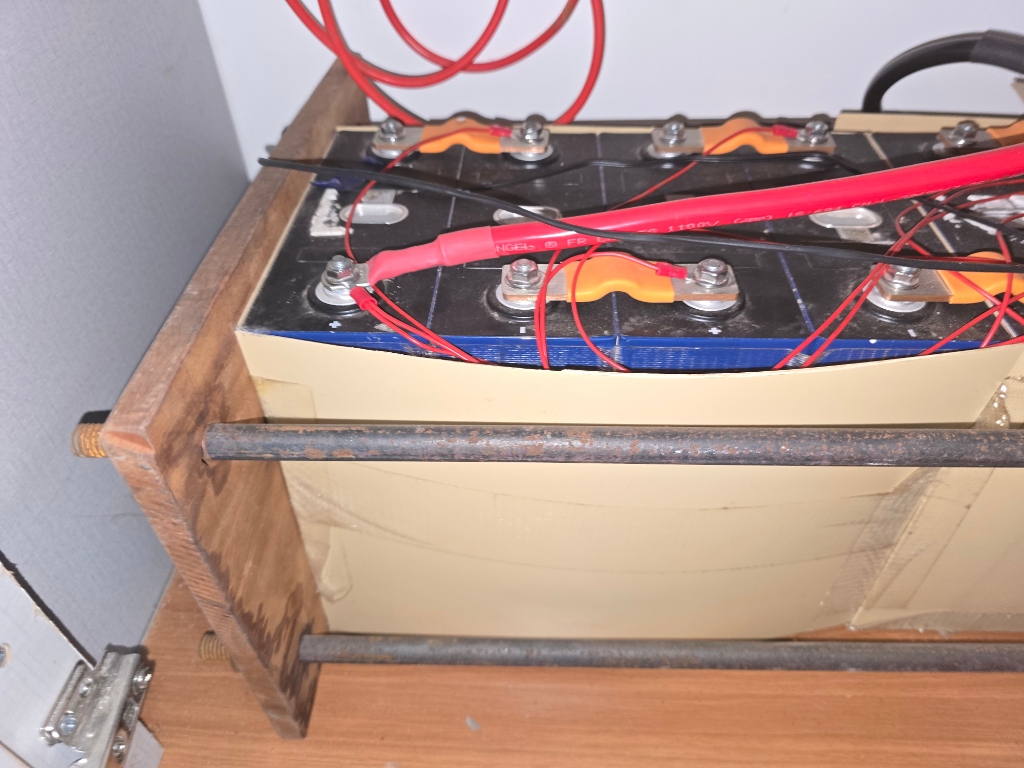
The heat issue vanished instantly. The eight cells were finally behaving like a properly assembled, tightly compressed 24V battery bank.
But the damage to the equipment was already done. Kanyakumari gets hit by two separate monsoons a year (the Southwest and the Northeast). After two years of enduring intense terrace heat and monsoon humidity, my Sorotec inverter finally gave up the ghost, and it took my JK BMS down with it.
The 2026 Permanent Fix: Deye & Relocation
In January 2026, I decided to do it right. I dropped ₹69.5k INR on a much heavier-duty piece of equipment: the Deye SUN-3K-SG04LP1-24-EU-SM1.
I was unfortunately “stuck” buying a 24V inverter because I had already invested so much money into my 8-cell 24V battery bank, but the Deye is a completely different beast. Most importantly, it is IP65 rated. My house is only a few hundred meters from the sea, so having equipment that is sealed against salty, humid ocean air is non-negotiable.
I also finally moved the entire setup. I carried the 50kg battery bank and the new inverter down from the sweltering terrace to the L1 (first floor). I had to run thick 6 sq mm DC solar wire all the way from the roof panels down to the new inverter location, but the temperature difference was worth it.
I installed a brand new JK BMS, and it is holding up flawlessly. Even under a heavy 3kW load, the cell voltage delta stays perfectly balanced at under 10-15mV.
The Metrics: Scraping the Sun
You didn’t think I was going to buy a piece of hardware and not put it in Grafana, did you?
I wrote a custom Python tool called deye-prometheus. It connects to the Deye inverter, scrapes all the live solar, grid, and battery metrics, and exposes them to Prometheus. Now, I can open Grafana from my apartment in Mumbai and watch the Kanyakumari sun charge my edge node in real-time.
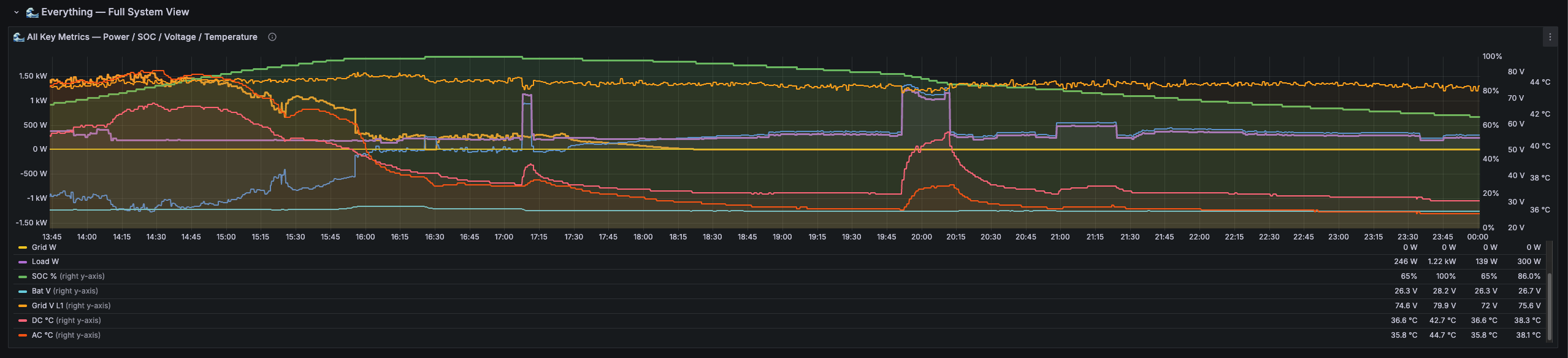
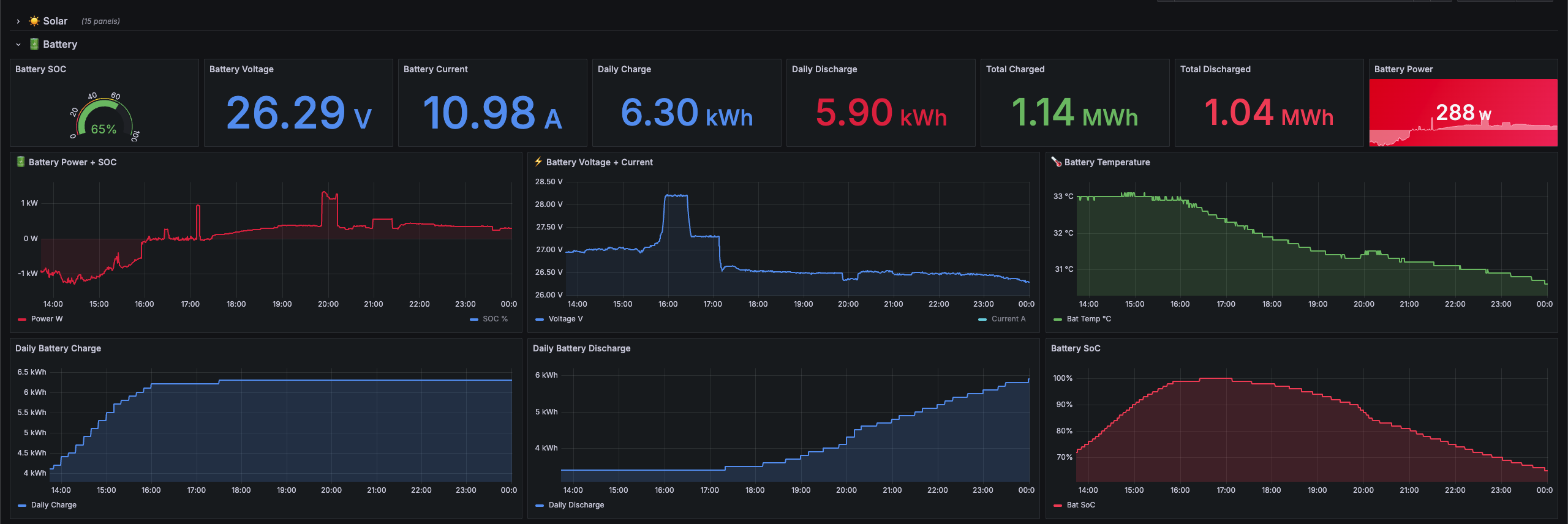
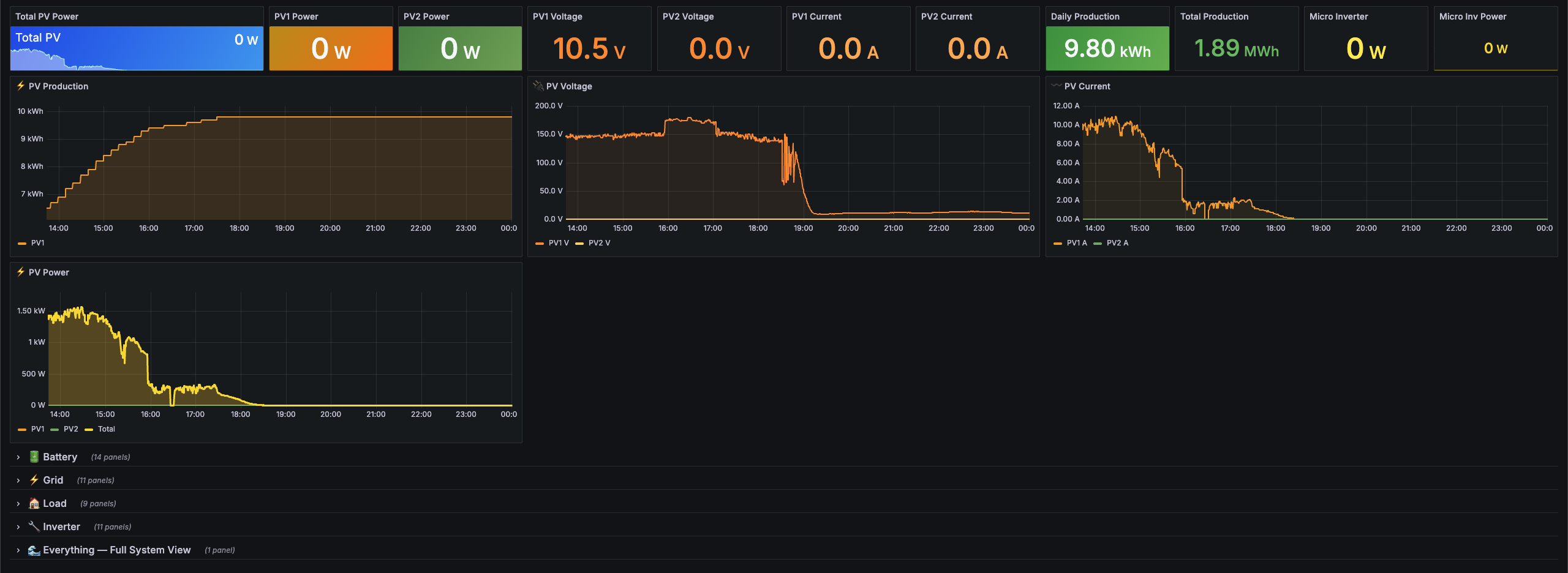
The Numbers (Jan 2026 - Aug 2026):
- Solar PV Production: 1.87 MWh
- Total House Consumption: 2.04 MWh
- Discharged from Battery: 1.0 MWh (49% of usage)
- Direct PV Consumption: 0.74 MWh (36% of usage)
- Imported from Grid: 0.3 MWh (15% of usage)
- Exported to Grid: 0 MWh (No net metering allowed yet)
Conclusion: Threatening the Power Grid
Is this setup worth the financial ROI? Absolutely not. Is it a headache? Sometimes. Does it give me absolute energy independence? 100%.
During a total grid blackout, I can casually turn on my air conditioner. The batteries handle it effortlessly.
In fact, my reliance on the grid has dropped so low that my monthly electricity bill is usually ₹0 (at most ₹100-200, which is barely a couple of dollars).
With the free electricity allowance and my solar setup, my grid usage had dropped so low that the local TNEB officials actually showed up at my house and threatened to cut my electrical connection because they thought the meter was broken or abandoned! I literally had to walk them outside and point at the solar panels just to get them to leave me alone.
So there it is. My edge node isn’t just highly available on the network side, it runs almost entirely on the sun.
(And yes, Uptime Kuma is still green).